Contemplation: Dinner at Four
Health research suggests that eating earlier in the evening is much better than later in the evening. When I was growing up in India, eating dinner at 9 or 10 at night was the norm. Little kids ate by 8. In my undergrad dining room in Delhi, I think we ate by 7.
Now I eat at 4 or 5 in the evening.
The light is still generous, and the day is uncertain about becoming a shadowy dark. Outside the campus of my independent living community people are still driving home from work, children are still playing, and some adults are wondering whether to cook dinner or simply order take-out.
Eating early is a small act of acceptance. I no longer need to wait for the world to tell me when the day is finished. I can simply listen to my own body. I’ve always been a person of habit and routine. I used to roll out of bed in the early mornings and stand in the shower, visualizing my daily work calendar and running through the “must-dos” for the day ahead. Now, I scroll through my phone messages, delighting in seeing the sun streaming through my blinds, high above the green expanse and bordering parking spaces below. Then, feed Kobi, my cat, get coffee brewing and my teeth brushed. Ready for the gym by 8 or 8:30 latest. Time has slowed for me. It’s reflected in my calmness (something my recent acquaintances take for granted but wasn’t how others, years ago, saw me). I was fast out of the gate so to speak; chasing the day like an Olympian and ending up an exhausted Sisyphus, often resentful and disgruntled. Always chasing.

Contemplation: Learning to Live Together
For most of our history, people lived in small groups where kinship was the glue that held society together. Trust was personal. Obligations were familial.
Then something extraordinary happened.
Thousands of years ago, human beings began gathering in larger settlements. Along the rivers of Mesopotamia, the Nile, the Indus, and the Yellow River, villages grew into towns and towns into cities. A city develops when human beings decide that their fate is intertwined with the fate of people beyond their family, tribe, or clan.
How could people, unknown to each other, live in close proximity and in peaceful harmony? How could the familial trust be extended to large groups of strangers?
Civilization entered a spellbinding phase. An agreement that all could accept had to be created. Rights and obligations could be recognized even without a family connection. Trade required agreements. Property required boundaries. Water systems required cooperation. Disputes required resolution. The social contract, the commonweal, grew from this necessity.
Civic laws were not lofty declarations about freedom or equality. They were practical tools designed to prevent chaos. The community was larger than any individual. Rules applied not only because a ruler commanded them but because life together depended upon them.
In the simplest terms, we agree not to take what belongs to another because we want our own possessions protected. We submit disputes to a common authority because endless retaliation benefits no one. We accept obligations because we seek the benefits of belonging. The gradual, millennia-old, expansion of this very contract is the society we inhabit today.
This idea is humanity’s greatest achievement. Individuals of different languages, beliefs, occupations, and histories inhabit the same space. Governance and political ideas in a public realm must constantly negotiate personal interests with collective needs.
When the common trust weakens, the social contract frays. Public institutions lose legitimacy. The belief that government serves the common good gives way to suspicion that it serves only the powerful or the connected. The city remains physically intact while its civic spirit erodes. All of us know this only too well. I’ll spare you the soap-box speech.
The lesson I want to point out is that successful communities are built on trust. Trust that we will accept the common good.
I live in an intentional community. There are a few thousand of us. We are lucky. We are not hedged in and stacked on top of each other. Spread over 120 acres, we all know and accept the ground rules of community behavior, with courtesy, a smile, and acknowledgment that all people need to be treated equally and well.
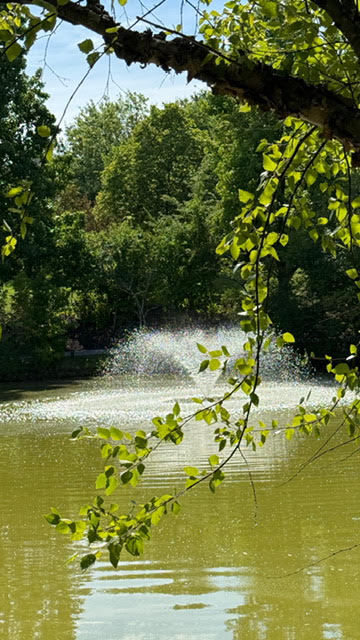
I live in a larger world where the commonweal is fractured and, in some places, in complete disregard. I am grateful for my intentional community, reminding me that we are often capable of doing what is just and right.
(All photographs courtesy of author. Reproductions prohibited without written permission)
Such a thoughtful, important post. A blessed to be living amid such tranquil surroundings.