“It is not the strongest or the most intelligent who will survive but those who can best manage change.” (Attributed to Charles Darwin but there is no definite passage in Origin of the Species that uses these words. However, the adaptability of a species is the single-most important element for survival.)
First show of the day in a Classical Revival theater, built in 1922, the oldest in this area in continuous use. I see Reading Lolita in Tehran. Despite its condensed screenplay from real-life events, it captures the shivering unveiling of a world out of control for a set of well-to-do young Iranian women at the time of the 1979 revolution and the solidified hardline years twenty years later. We see them first in class at the university being taught by an American-educated Iranian woman on English literature. Then being driven out by the morality police and later by the hardliners into a secret gathering of a few women at the professor’s home where they discussed the context of The Great Gatsby, the death of the American Dream and the doomed affair with Daisy; the meticulously structured cotillions and reels in Jane Austen’s world that mirrored the stylized, iron-clad manners of Regency England; and the most challenging narrative of the film’s title, Nabokov’s Lolita. The unreliable narrator, justifying monstrous reality with the seduction of words. And why do these women risk their lives to study literature?
I quote Susan Sontag: “. . . It’s exciting to me to subscribe to something that’s foreign to my earlier taste. Not in an unfriendly spirit with respect to the earlier work—but just because I need new blood and new nourishment and new inspiration. And because I like what I’m not, I like to try to learn what isn’t me or what I don’t know. I’m curious. “(Mark O’Connell, “The Intellectual”, Slate, Nov. 5, 2013).
I am in a Zoom reading class with about 10-15 others led by a writer from possibly the most recognizable weekly magazine of the last century in the United States. She’s not an academic. She is very well-read and profoundly excited about the texts she talks about. Her teaching is in engagement with the text and her students. She’s not in it for the money because her sessions routinely go to 90 minutes when we pay for only 60. She has propelled me from Calvino to Han Kang and Doris Lessing to Woolf, to Dostoevsky to Tolstoy. I gorge on the engagement and curiosity of the expanding world formed by the best of literature, to break our prejudices, to read characters as humanely as possible and not stick figures shoving a storyline.
For all of that I’m grateful.
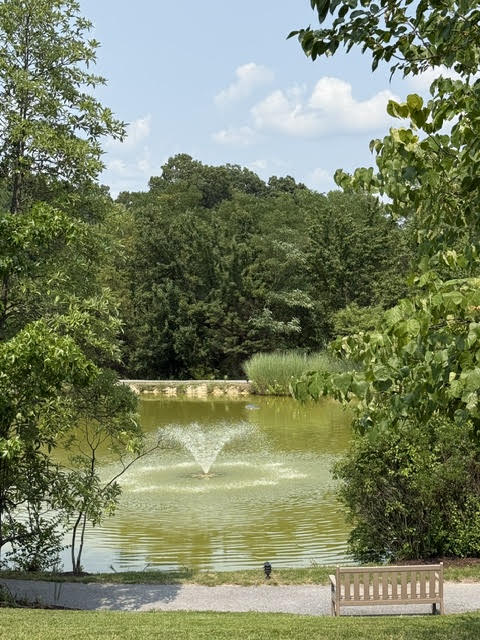
(Photo courtesy author. All Rights reserved. No reproductions without written permission)
Each time I watch a film or see a series on TV or read a novel, I am curious —about structures, about language and the weaving of it, of characters, and what music can be created with so few contrivances.
In a world today where gangsters masquerading as people who govern rule most of us, hope is a word in snickering disrepute. Yet hope surrounds me and I remain one of the lucky ones who wakes up with the sun streaming through the blinds in my bedroom on the upper floor of a red-brick multistory building, one of many on a 120-acre wooded campus, the largest continuing care retirement community in the U.S. And a community it is because of the ethos of the organization and the active involvement of every member of the community. Suddenly, I’m living in a place where the very best of civic life and engagement is practiced willfully and unhesitatingly. If someone had said that I’d write about my current situation in this fashion, I’d have laughed a few years ago.
If we engage in whatever way we can, then hope isn’t something indescribable. It’s a lived reality. It’s the aging lifting weights, on a treadmill, walking to the community gardens, doing the crossword puzzle, reading, and on and on.
It’s about the incredible upsurge of frustration and anger that the CJP (the satirical Cockroach Janata Party in India) reeled in and then toppled a cabinet minister in India and put the reigning government on notice. A movement of under-25s, GenZs. Facing baton charges, water cannons, pellet guns and threats of imprisonment, hope is what fuels their ardor. Without hope, the truckloads of memorable banners and memes mocking the ruling powers would be totally lacking.

It is with hope that I have uprooted my life and placed it on track for the final lap. Without fear, regret, or rancor. I can’t march in India, and I can’t rail against the gangsters all my waking hours. I can resume mentoring young students via Zoom. They are not privileged. I can cajole them to think about how to create opportunities, how to withstand failure, how to be curious and learn. I can actively be a member of my community, with hope.
My blog is called Alokothai, Bengali for “Where is the light?” A very old friend recently went to Iceland and took this photo of a cavern of ice and the blue sky. I leave that for you to admire. Always seek the light. Always. And the darkness is not forever. Never.

(Photo credit: Marcia Joiner. All Rights reserved. No reproductions without written permission)