“The real voyage of discovery consists not in seeking new landscapes, but in having new eyes.”
(~ Marcel Proust, Remembrance of Things Past, vol. 5, “The Prisoner”)
*****************************************
My mother was my first and best friend for my first sixteen years. Yes, yes, I know what you’re thinking —mama’s boy, sons and mothers, and all the other tropes. We bonded as fellow pilgrims in a volatile household, both curious about the world around us, lonely in a feverish public arena, and both boundless readers.
In essays in recent years, I’ve written about swallowing her wedding ring as a child; about being belted to the bedpost by her while the household swirled around me. Her frustrations and anger were comical to me as a young person, only to be deeply melancholic in later life.
In a few days, I’ll mark (and I might be the only person in this world who’ll do so) her 105th birth anniversary on April 14. As a child I used to wonder how we could share the same Zodiac sign. As I didn’t see myself as having any of the traits she did.
I learned the word “proscribe” from her. Often, I would come across words in my not-age-appropriate readings, and I’d ask her for explanations. Born in 1921 and a teenager at the height of the nationalist movement for Independence in Bengal, Ma knew all about proscription. And she’d tell me thrilling stories about hearing Subhas Bose broadcasting from the Andaman Islands and using the now-famous call to arms “Delhi Chalo” (Go to Delhi).
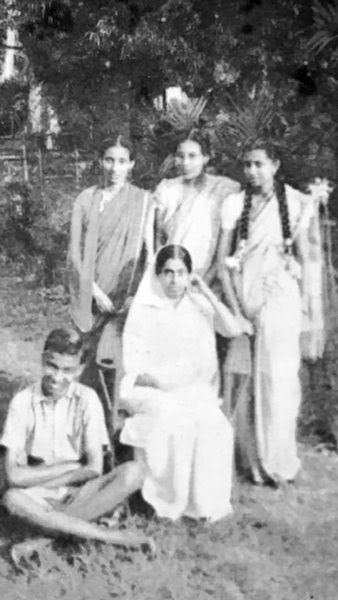
Ma, middle standing, with her family. 1940s. L-R: Purnima (2nd oldest); Ira (Putul; Chotomashi, youngest sister); Didu (her mother, sitting; Mama (brother, Khokon; Pradip. He was 11 or 12 in this photo)
She was 11 when her father, a young and quite accomplished English literature student, who was the postmaster general of Bengal, died of meningitis at 33, long before vaccines for the disease had been developed. Her mother, widowed at 32, had three girls, all younger than my mother, and a son, who was born posthumously. My mother’s life, when I was growing up, often flickered in my mind’s eye like some grainy Satyajit Ray black-and-white film of decay and sorrow. I was foolish as a young person because I calipered her worth by public achievements and not by her formidable resilience and inner spirit.

N. K. Dutt, Ma’s father. 1920 (?)
Today, she and I’d have a blast watching K-dramas with its intricate plots and familial dramas in recognizable cultural rhythms. Friday night radio plays in Kolkata were our staples. The plots were historical or contemporary with mistaken identities, miscarried justice, love and tenderness hampered by societal inequities. We graduated quickly to listen to radio running commentaries of cricket matches and first-division soccer matches. I taught her how to keep score in cricket and she was hooked. In those days, without smartphones, I couldn’t listen to matches while at school and would race back to check the scores. My most vivid memory is of the 1959 Kanpur Test between Australia and India and Jasu Patel’s wondrous 9 wickets for 69 runs, which laid the groundwork for the first-ever Indian win over the Aussies.
She married at 21 to a man who was almost larger than life with a bewildering personality.
While he raced toward the sun, I don’t think he’d been able to do as much as he did without her. Their first born, a girl, died within a year of birth in 1943. My mother was 22. She never talked about Reena except when I asked the few questions I could. Then in 1946, my sister Swapna was born and my father left for the U.S. on a freighter. Ma was 25 and she and Didi (my sister) lived with an aunt on the outskirts of Kolkata. My father’s parents weren’t close to him (that would require another essay) and my mother’s family were in South Kolkata. Didi was over a year old when my father returned. My father was a tornado of accomplishments. While he toured the world, Ma stayed with us. But when needed, she stepped up without fanfare. Helen Keller and Polly Thompson visited the blind school in 1955. Ma translated in Bengali Helen Keller’s speech to the students in English, decoded by Polly Thompson.
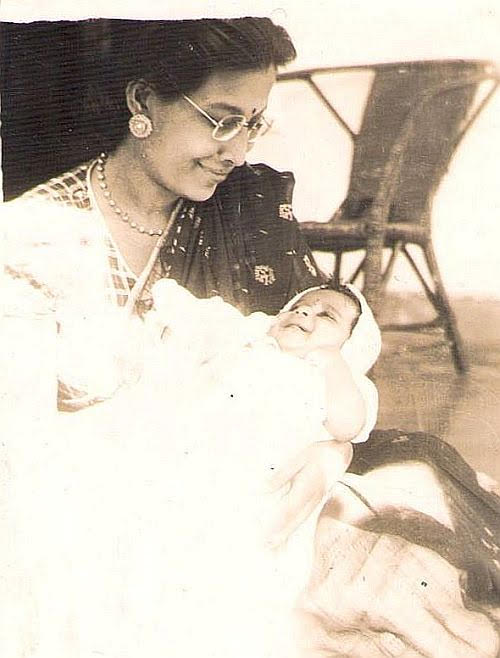
Ma with Didi, 1946.
Ma let me read everything and anything. She looked at me quizzically when I was reading Pearl Buck’s Good Earth. I was eleven. Much later, I thought the look must have been about the birth in the rice fields. Peyton Place was another matter as I was a hormonally explosive 13-year-old. Ma, too, read whatever she could lay her hands on. Bengali novellas, magazines, and English “women’s” magazines. They carried short fiction or serialized stories. I read them too. In allowing me to be delighted with reading, she gave me one of the most formidable tools for getting through my life.
And then there was the world of ideas.
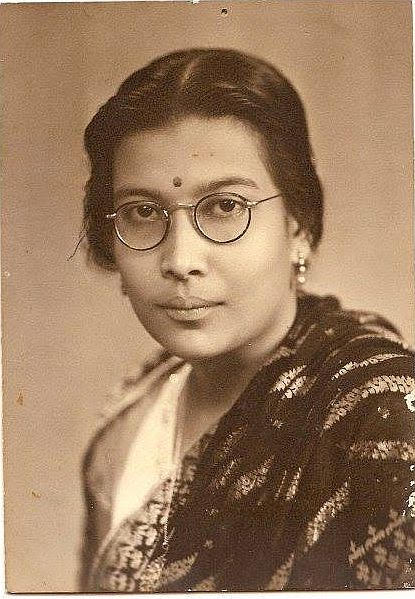
Ma, August 1942
Without her, I’d be an ignoramus about the Ramayana and Mahabharata. Both were required texts in Bengali in elementary and middle school. I hated learning the language (to my eternal chagrin), but she was disciplined and determined. She’d wake me up at dawn, crawl onto my bed, under the mosquito netting and help me read the days of my tests.
Years later, when I went away to college, hundreds of miles away, I didn’t stop for a second to think about how she must have felt, being left behind. The same as when I jetted to the US. College changed my life. It changed my life because not only did I start understanding about the roots of inequality and economic injustice in India, but I also came upon a political movement, disastrous in hindsight, and full of hope and immediacy. As I was leaving once, when I was unsure when I’d see my parents again, she said to me that she would do the same in my shoes. I remember. How could I forget? She understood exactly what was propelling me toward either a glistening dawn or historical bankruptcy.

Ma with Didi and myself, Aug. 1966
When I graduated from college, I couldn’t pay my final exam fees to collect my seat number because I’d squandered my money at the college café and the university coffee shop. I certainly couldn’t ask my father. I asked Ma. She sold a gold bracelet and I graduated college.
Ma died in June, 1989 ( see Revisiting the Mines, “ Notes of a Summer”). She was 68. If she were alive, I’d ask her to come and spend a few days with me at the independent living apartment that I’ll start living in this summer. At 76, I think she and I would have a lifetime to talk about.
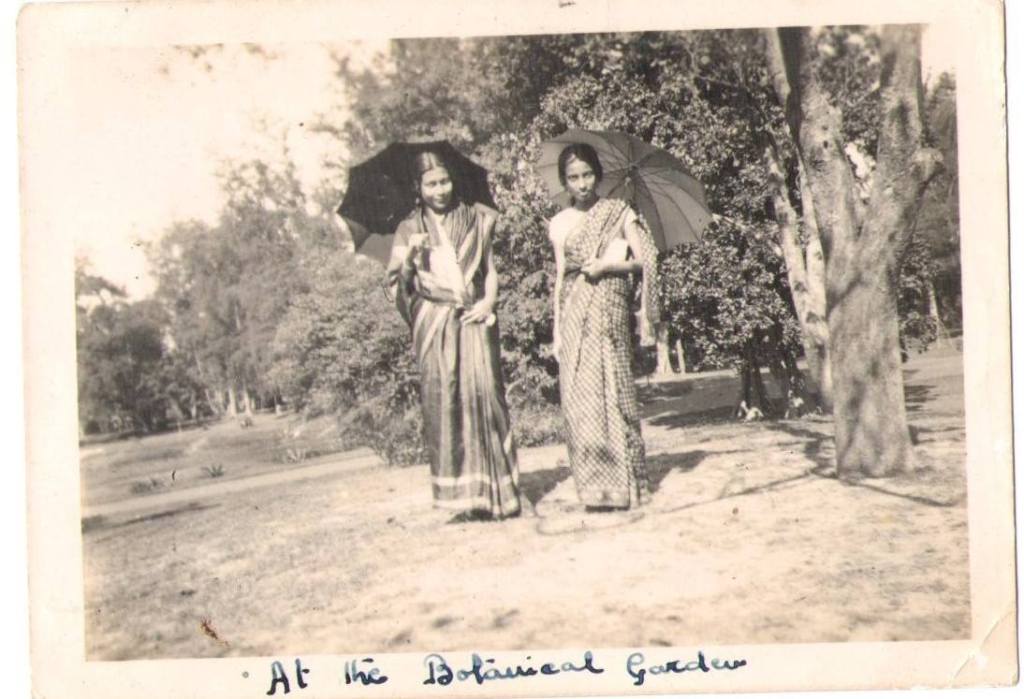
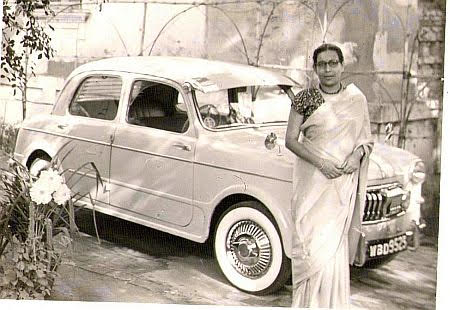
TOP: Ma and her sister, Purnima (Bablu), my Boromashi (oldest aunt), 1942-43.
BOTTOM: Ma at Behala, 1950s. (Am salivating at the white-walled Fiat!!!)
Amit! I loved this piece so much! And the photos of your mother are wonderful. How beautiful she is.